
You've said it before. Probably dozens of times. The weekend arrives, you overindulge a little, and somewhere between Sunday brunch and Sunday night you make the declaration: "I'll start Monday."
Monday feels clean. Monday feels possible. Monday is when the better version of you finally shows up.
Except Monday comes, and by Wednesday that version has already disappeared. Again.
This isn't a willpower problem. It's a design problem. And until you understand why Monday keeps failing you, you'll keep starting over.
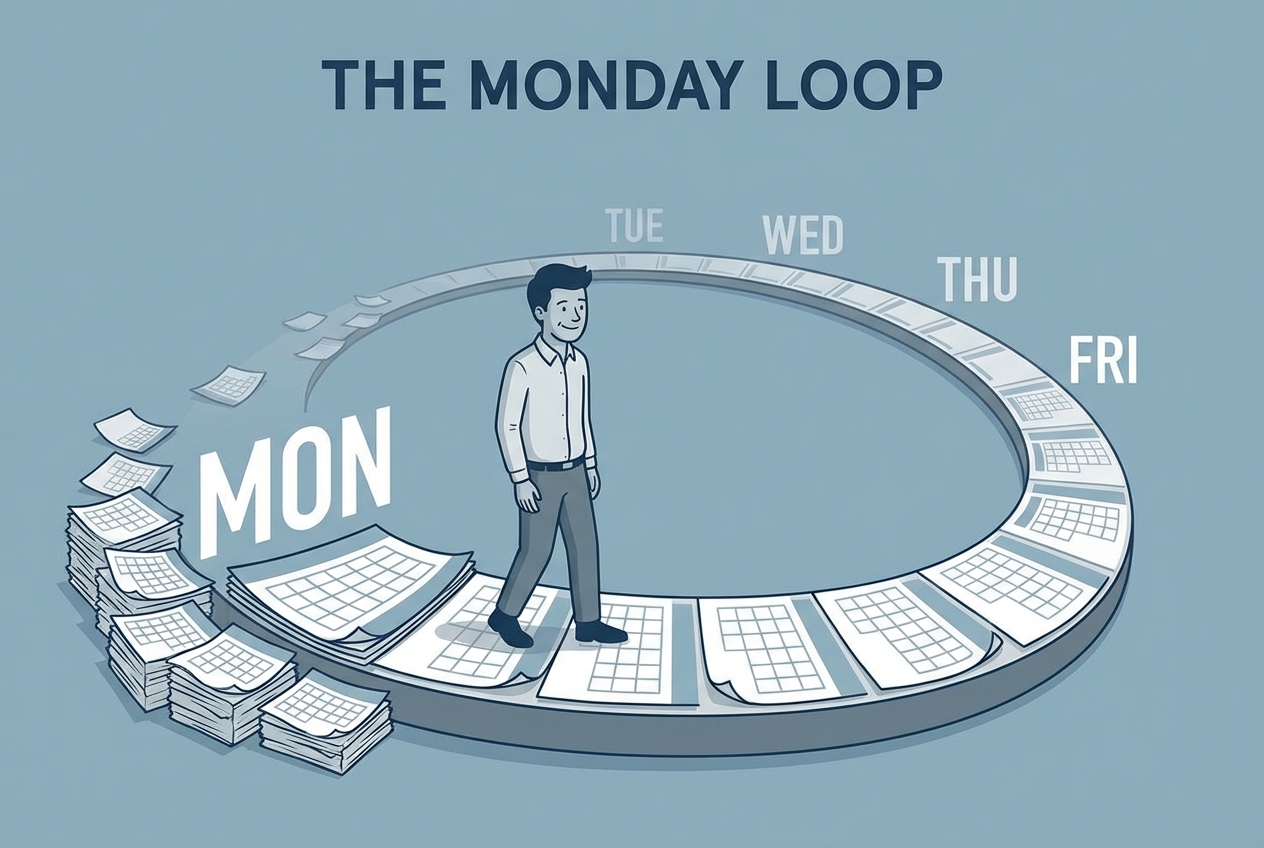
The Fresh Start Effect (And Why It Backfires)
There's actual science behind your Monday obsession. Researchers call it the "fresh start effect"—the psychological tendency to pursue goals more vigorously after temporal landmarks like new weeks, new months, or new years.
The theory is that these fresh starts create mental accounting. The old you, with all your failures, gets filed away. The new you gets a clean slate. Monday becomes a psychological reset button.
And it works. For about 48 hours.
Studies on gym attendance show a predictable pattern: sign-ups spike in January and on Mondays. Attendance peaks early in the week. By Thursday, the crowds thin. By the following Monday, people are "starting fresh" all over again.
The fresh start effect gives you a burst of motivation. But motivation is a depreciating asset. It's highest at the moment of decision and lowest at the moment of action. By the time Thursday afternoon arrives—when you're tired, stressed, and facing the actual work—that Monday motivation is a distant memory.
Here's the problem: you keep investing in a currency that loses value by midweek.
The Real Problem With "Starting Monday"
The deeper issue isn't timing. It's what "I'll start Monday" actually reveals about your approach.
When you postpone to Monday, you're outsourcing your change to a future version of yourself who will somehow be more disciplined, more motivated, more capable. You're betting that Future You will succeed where Present You keeps failing.
But Future You will have the same brain, the same habits, the same environment. The only thing that will be different is the day of the week.
"I'll start Monday" feels like a commitment. It's actually an escape. It lets you feel like you're doing something about the problem without doing anything about the problem. The intention satisfies just enough of the psychological need for action that you can relax—until Wednesday, when reality returns and the cycle restarts.
This is why serial procrastinators can spend years in perpetual postponement. Every Monday provides just enough hope to avoid confronting the real issue: intentions alone don't create change.
Why Willpower Is Not a Strategy
Here's what most self-improvement advice gets wrong: it treats willpower as the engine of change.
Push harder. Want it more. Discipline yourself. The implication is that successful people simply have more willpower than you do.
They don't.
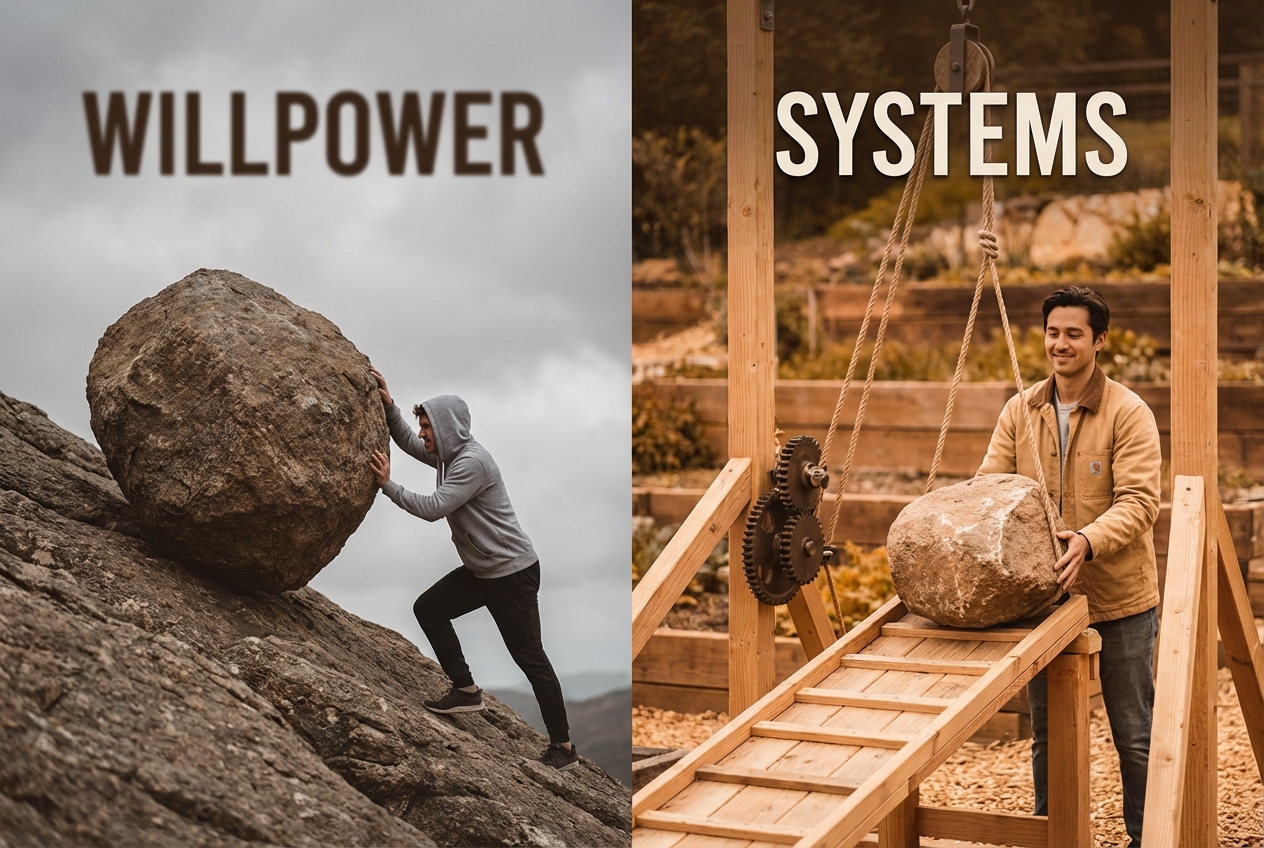
Research on self-control consistently shows that people who appear to have strong willpower actually use it less. They're not better at resisting temptation—they're better at avoiding it. They've designed environments and built systems that don't require constant willpower expenditure.
Willpower is a finite resource. It depletes throughout the day. It's weaker when you're tired, stressed, hungry, or emotionally drained—which is to say, most of real life. Any system that depends on willpower is a system designed to fail.
That's why motivation works on Monday morning and disappears by Thursday afternoon. Monday-morning-you is rested, optimistic, full of resolve. Thursday-afternoon-you is depleted, distracted, and looking for the path of least resistance.
You don't need another Monday. You need a system that works on Thursday afternoon when motivation is gone.
The Shift That Actually Works
James Clear, in Atomic Habits, makes the distinction: the difference between outcome-based goals and identity-based change.
Outcome-based: "I want to lose 20 pounds."
Identity-based: "I am someone who takes care of their body."
The first is a target. The second is a trajectory. And the difference matters more than it seems.
When change is outcome-based, every action is a means to an end. You exercise to lose weight. When the scale doesn't move fast enough, motivation evaporates. When the goal is reached—or abandoned—the behavior stops.
When change is identity-based, every action is a vote for the person you're becoming. You exercise because that's what someone like you does. The behavior reinforces the identity, which reinforces the behavior. It becomes self-sustaining.
This is why some people maintain habits effortlessly while others white-knuckle their way through every week. The effortless ones aren't more disciplined. They've just aligned their habits with their identity. The action isn't a sacrifice—it's an expression of who they are.
Building Systems That Don't Need Motivation
So what does this look like in practice?
First, stop waiting for Monday. If Thursday at 3 PM isn't a good time to start, Monday at 9 AM won't be either. The conditions will never be perfect. Start now, start small, and iterate.
Second, design for your worst days, not your best. Any system that only works when you're motivated, rested, and in the right mood isn't a system—it's a wish. Build habits that are small enough to execute even when you don't feel like it. Two minutes of stretching beats zero minutes of the workout you skipped.
Third, focus on identity before outcomes. Instead of "I want to read more," try "I'm someone who reads." Instead of "I want to be healthier," try "I'm someone who moves their body daily." The behavior follows the belief.
Finally, build in reflection. Notice what's working and what isn't. Adjust. A system that can't adapt is a system that will eventually break.
What to Do Next
Here's a question worth sitting with: What have you been postponing to "someday" that you could start—imperfectly, incompletely—right now?
Not Monday. Now.
Pick one small behavior that aligns with who you want to become. Make it small enough that you could do it on your worst day. Then do it today. And tomorrow. And the day after.
Don't wait for motivation. Build a system that doesn't need it.
Because the person you want to become doesn't live on Monday. They live in the accumulated actions of ordinary Thursdays—the days when nobody's watching, when motivation is gone, when the only thing keeping you going is the system you built and the identity you're choosing.
When you're ready to build systems that actually stick, Moira can help you design habits around who you're becoming—not just what you're trying to achieve.